
Top 15 Home Service App Development Trends in the USA for 2026
- Kevin Owen

- Jul 13
- 4 min read
Introduction
The home services sector in America is currently undergoing many changes as companies adopt technological transformation in order to keep up with the ever-changing consumer demands. Home service companies are adopting technology that will enable homeowners to book their services in an easier and more efficient manner. In the face of stiff competition, on demand home service app development is now mandatory for any company hoping to succeed.
This article looks at the top 15 home service app development trends that will define the USA market in 2026.
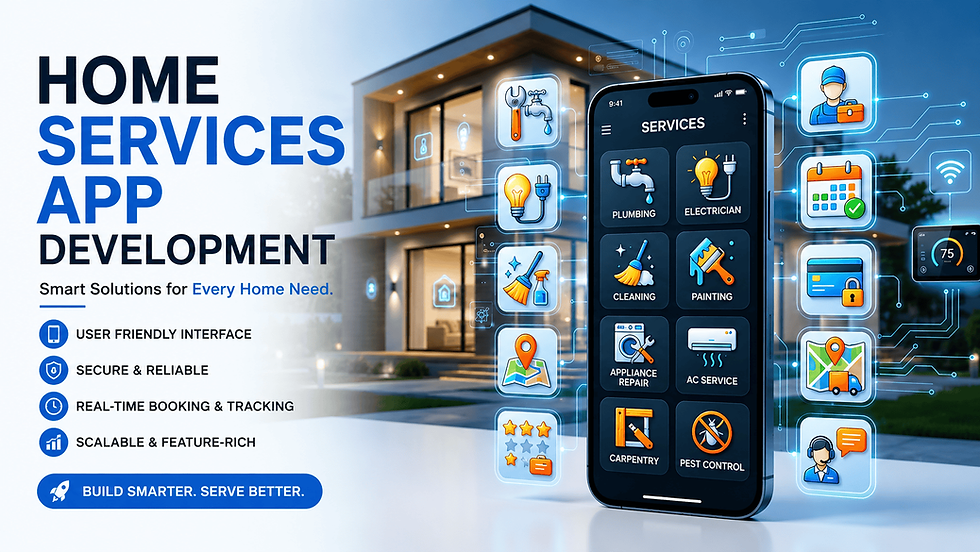
Why Home Service Apps Are Evolving
Modern consumers expect instant bookings, transparent pricing, real-time updates, and personalized experiences. At the same time, service providers seek automation tools that reduce operational costs and improve workforce productivity.
Some key growth drivers include:
Increasing smartphone usage
AI-powered automation
Smart home adoption
Digital payment growth
Customer demand for convenience
Cloud-based business management
These factors are accelerating innovation across the home services sector.
1. AI-Powered Booking Systems
Artificial intelligence is simplifying appointment scheduling by automatically matching customers with the most suitable service professionals based on availability, location, and expertise.
Benefits include:
Faster bookings
Reduced scheduling conflicts
Improved technician utilization
Better customer satisfaction
2. Smart Technician Dispatch
AI-driven dispatch systems analyze traffic, technician skills, and customer locations to assign jobs more efficiently.
Advantages include:
Reduced travel time
Lower fuel costs
Faster response
Increased daily appointments
3. Predictive Maintenance
Instead of waiting for equipment failures, AI analyzes usage patterns to predict maintenance requirements before problems occur.
Businesses can:
Reduce emergency repairs
Increase customer trust
Improve service planning
4. Voice-Enabled Booking
Voice assistants are making home service booking easier by allowing customers to schedule appointments using simple voice commands through smartphones and smart speakers.
5. IoT Integration
Connected home devices automatically detect maintenance needs and notify users when servicing is required.
Examples include:
HVAC systems
Water leak sensors
Smart security devices
Connected appliances
6. AI Chatbots for Customer Support
Intelligent chatbots provide 24/7 customer assistance by answering questions, booking appointments, and resolving common issues instantly.
Benefits include:
Faster response times
Reduced support costs
Improved customer experience
7. Real-Time Service Tracking
Customers increasingly expect to track technicians in real time, receive arrival updates, and monitor job progress through the mobile application.
Learn More About Home Service App Development
To know more in detail, click the video link given below.
8. Contactless Digital Payments
Secure digital payment options continue to gain popularity, allowing customers to complete transactions quickly through credit cards, digital wallets, and contactless payment systems.
9. Personalized Customer Experiences
Artificial intelligence analyzes customer behavior and service history to provide customized recommendations, maintenance reminders, and promotional offers.
10. Subscription-Based Service Models
Many businesses are introducing membership plans that offer scheduled maintenance, discounted services, and priority support through recurring subscriptions.
11. Augmented Reality (AR) Assistance
AR technology enables technicians to diagnose issues remotely while helping customers better understand repair processes through visual guidance.
12. Advanced Data Analytics
Business owners use analytics dashboards to monitor:
Customer behavior
Booking trends
Technician performance
Revenue growth
Service demand
These insights support informed business decisions.
13. Sustainable Service Management
Eco-friendly practices are becoming increasingly important. Apps now help optimize technician routes, reduce fuel consumption, and encourage environmentally responsible service operations.
14. Enhanced Cybersecurity
As customer data becomes more valuable, businesses are investing in stronger security measures such as:
Multi-factor authentication
Data encryption
Secure payment gateways
Fraud monitoring
Robust security builds customer confidence and protects sensitive information.
15. Cloud-Based Scalability
Cloud infrastructure allows home service businesses to scale operations without compromising performance.
Benefits include:
Faster deployments
Better reliability
Easy software updates
Improved data accessibility
Essential Features for Modern Home Service Apps
To stay competitive in 2026, businesses should include:
User registration
Smart booking
Real-time tracking
AI-powered chat support
Multiple payment options
Push notifications
Customer reviews
Technician management
Admin dashboard
Service history
In-app messaging
Analytics dashboard
These features improve operational efficiency while delivering exceptional customer experiences.
Business Benefits of Adopting Emerging Trends
By embracing these technologies, companies can:
Increase customer satisfaction
Improve technician productivity
Reduce operational costs
Automate repetitive tasks
Increase booking conversions
Strengthen customer loyalty
Support business scalability
Organizations investing in on-demand home service app development are better positioned to meet evolving customer expectations and maintain a competitive edge.
Frequently Asked Questions (FAQs)
Why are home service apps growing rapidly in the USA?
Increasing smartphone adoption, digital convenience, AI automation, and customer demand for instant services continue to drive market growth.
How does AI improve home service applications?
AI automates scheduling, technician assignment, customer support, predictive maintenance, and personalized recommendations.
Why is IoT integration important?
IoT devices can automatically detect maintenance issues and trigger service requests before equipment fails.
Are subscription models beneficial?
Yes. Subscription plans provide recurring revenue while encouraging long-term customer relationships.
Why should businesses invest in cloud infrastructure?
Cloud platforms improve scalability, reliability, security, and application performance while supporting future growth.
Conclusion
In the United States, the home services sector is currently embarking on a new phase of digitalization through technologies like artificial intelligence, Internet of Things, cloud computing, AR, and analytics, thus changing customer needs and business processes. Those companies that utilize innovative tendencies in their operations will benefit from providing quick, smart, and customized services.
Development of an on-demand home services app provides opportunities for establishing scalable, reliable, and future-proof systems that allow making bookings, managing workers, engaging customers, and fostering further development. In 2026, those companies that will innovate and adapt to constantly changing market requirements will have great chances to succeed in the highly competitive home services sector.


Comments