
How to Launch an AI Streaming Startup Without Copying Netflix
- Kevin Owen

- May 25
- 3 min read
However, by 2026, the streaming sector will go far beyond the conventional subscription-based streaming models established by Netflix. Even though Netflix shaped the current generation of OTT entertainment, it is becoming clear to a lot of startup businesses trying to enter the market that mimicking its structure is not enough to make it big in the industry anymore.
Consumer expectations have become much more sophisticated. People today seek personalized content, interactive streams powered by AI recommendations, and a content ecosystem tailored for a specific interest group.
If you plan to launch your streaming app platform, your best bet is innovation rather than imitating your competitors.
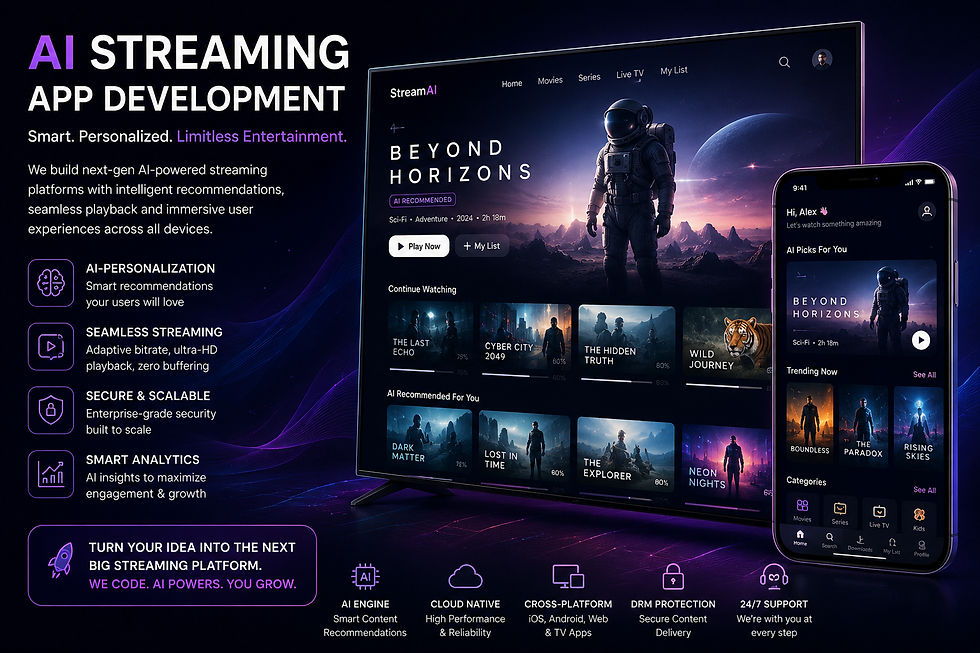
Innovation is what modern AI-based streaming app development is all about.
Why Copying Netflix Is No Longer a Winning Strategy
Large streaming platforms already dominate mainstream entertainment markets with:
Massive content libraries
Global distribution networks
Advanced recommendation engines
Multi-billion-dollar infrastructure
Startups attempting to replicate these ecosystems often struggle with:
High content licensing costs
Expensive infrastructure scaling
Weak audience differentiation
Low retention rates
In 2026, users are no longer impressed by “another streaming app.” They are looking for platforms that offer unique and personalized experiences.
Niche Streaming Platforms Are Growing Faster
One of the biggest opportunities for modern streaming startups is niche-focused content ecosystems.
Many successful platforms now focus on:
Sports streaming
Educational content
Creator-driven communities
Religious or cultural content
Regional entertainment
Gaming & esports streaming
Niche-focused platforms often achieve:
Better audience loyalty
Lower customer acquisition costs
Stronger engagement
Higher retention rates
Businesses planning to build streaming app ecosystems should focus on underserved audience segments instead of competing broadly.
AI Is Reshaping Streaming Platforms
Artificial intelligence is becoming the core engine behind modern streaming ecosystems.
AI-powered systems now optimize:
Personalized recommendations
Viewer retention prediction
Dynamic content feeds
Watch-time analysis
User engagement tracking
These technologies help improve:
Session duration
Subscription retention
Content discovery
User satisfaction
AI streaming app development increasingly depends on machine learning systems that understand audience behavior in real time.
Content Discovery Is More Important Than Content Volume
One major issue with traditional streaming models is content overload.
Users often spend more time searching for content than actually watching it.
Modern AI-powered streaming apps solve this by:
Curating personalized recommendations
Predicting user preferences
Optimizing homepage experiences
Prioritizing relevant content
Smaller platforms with strong AI personalization often outperform larger platforms with generic recommendation systems.
Cloud Infrastructure Is Essential
Modern streaming platforms require scalable backend systems capable of handling large volumes of real-time data.
A scalable streaming app typically requires:
Cloud-native architecture
Global CDN integration
Adaptive bitrate streaming
AI analytics systems
Multi-device synchronization
Without scalable infrastructure, platforms often face:
Buffering issues
Playback delays
Recommendation lag
User churn
Modern streaming app development depends heavily on cloud scalability and real-time processing systems.
Interactive Streaming Is Becoming Mainstream
Modern users increasingly expect interactive digital experiences instead of passive viewing.
Streaming platforms now integrate:
Live chat systems
Watch parties
Creator interaction
Community engagement tools
AI-curated live feeds
Interactive engagement significantly improves user retention and platform activity.
For founders interested in understanding the full AI architecture and streaming workflow behind modern OTT systems, the detailed video below explains the process further.
Flexible Monetization Models Are Growing
Subscription-only models are no longer the only path to profitability.
Modern streaming startups increasingly use:
Ad-supported streaming
Creator subscriptions
Pay-per-view events
Hybrid monetization systems
Premium community access
Flexible monetization helps startups reduce subscription fatigue while improving revenue diversification.
Data & Analytics Drive Smarter Growth
Modern streaming ecosystems rely heavily on real-time analytics.
AI-powered systems help monitor:
Viewer behavior
Watch-time trends
Content performance
Engagement patterns
Subscription retention
Data-driven optimization helps platforms scale more efficiently while improving user experiences continuously.
The Future of AI Streaming Platforms
The next generation of streaming platforms will likely focus on:
AI-powered personalization
Interactive entertainment
Creator-driven ecosystems
Predictive recommendation engines
Real-time audience engagement
Streaming apps are rapidly evolving into intelligent digital entertainment ecosystems powered by automation and behavioral analytics.
Final Thoughts
Starting a company based on AI streaming services in the year 2026 is no easy task, and one needs to go beyond mimicking what Netflix has done. Creating an ecosystem of apps for streaming services in today's world needs personalized experiences using artificial intelligence, scalable infrastructure, engaging niches and audiences, and smart content discovery algorithms.
Firms that wish to create streaming application ecosystems in the future should not look back at old ways of developing such applications but should think about how they can stand out through differentiation and scalability.


Comments